
Learn expert tips to organize your kitchen for maximum efficiency. Save time, reduce clutter, and make cooking easier with these practical strategies.
Your Kitchen Works Against You More Than You Think
Most people don't realize how much time they lose in a poorly organized kitchen. You reach for a pan buried under three others, hunt for the lid that matches nothing, or find yourself walking back and forth across the kitchen just to make a simple meal. After years of working in homes and seeing kitchens of every size and style, the pattern is almost always the same — it's not the space that's the problem, it's how it's being used.
A well-organized kitchen doesn't just look better. It actually changes how you cook, how long cleanup takes, and how much stress you feel when you walk in the door at the end of a long day. The good news is that even small adjustments can make a dramatic difference.
Start With the Way You Actually Cook
The biggest mistake most people make is organizing their kitchen based on what looks neat rather than how they move through it. Your kitchen should be set up around your habits, not a Pinterest photo.
Think about what you cook most often. If you make eggs every morning, your skillet should be on the stove or hanging within arm's reach — not stacked inside a cabinet three pans deep. If you bake on weekends, your mixing bowls, measuring cups, and baking sheets should live in the same zone, not scattered across three different cabinets.
In many homes, we see cutting boards stored on the opposite side of the kitchen from the knives. That's a small thing, but it adds friction to every single meal prep. Friction is the enemy of efficiency.
The Zone System: Think Like a Professional Kitchen
Restaurant kitchens run efficiently because everything has a designated station. You can apply the same logic at home by creating simple zones: a prep zone near the sink and cutting board, a cooking zone around the stove, a plating and serving zone near the counter or island, and a storage zone for pantry items and dry goods.
Once you define these zones, put items back where they belong every time. It sounds obvious, but most kitchen chaos starts with things slowly drifting out of their zone over weeks and months.
The Cabinet and Drawer Problem
Cabinets tend to become a dumping ground for anything that doesn't have a clear home. One family we worked with had four different sets of measuring spoons across three different drawers. They weren't disorganized people — they just never had a clear system, so duplicates piled up without anyone noticing.
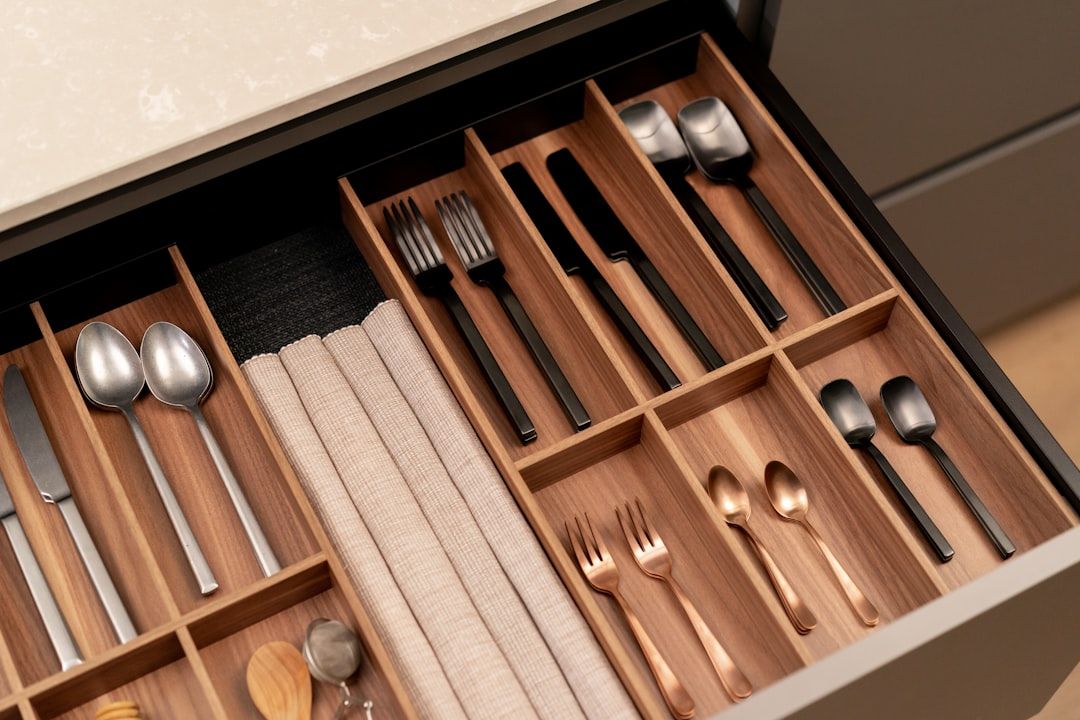
Start by pulling everything out of one cabinet or drawer at a time. Get rid of duplicates, broken items, and anything you haven't touched in over a year. Then use drawer dividers for utensils and adjustable shelf risers inside cabinets to double your vertical space. Stacking dishes flat is almost always wasted potential — a simple shelf riser turns one shelf into two.
For pots and pans, a vertical lid organizer mounted inside a cabinet door costs almost nothing and eliminates one of the most frustrating storage problems in any kitchen.
Countertops: Keep Only What Earns Its Place
Every appliance sitting on your counter should be something you use at least three to four times a week. If the air fryer only comes out on Sundays, it belongs in a lower cabinet or pantry shelf. Cluttered countertops make food prep harder and make the kitchen feel smaller than it is.
A clean counter also makes it easier to wipe down surfaces properly, which matters more than most people realize for kitchen hygiene — especially around areas where you handle raw meat or produce.
Don't Overlook the Pantry and Refrigerator
A chaotic pantry leads to buying duplicates of things you already have, which wastes money and takes up space. Group items by category — canned goods together, grains together, sn


